New Guinea Commerce

Governance, growth and next generation leadership in the Indo-Pacific

Category: Uncategorized

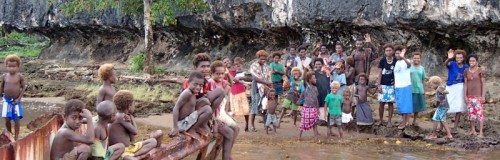
Should Sinking Islands in the South Pacific Worry Us?

The need for good governance persists

Sean Jacobs, Alochonaa (Dialogue), 30 April 2014

“Climate change is an issue that I will continue to talk about for as long as I have breath in my body,” said Kiribati President Anote Tong to the United Nations General Assembly in 2012. “This is a critical issue for the survival of our people and for all of humanity. It remains the greatest moral challenge of our time.”

Few images in the West are more emotive than a small island archipelago slowly being consumed by rising sea levels. A sense of guilt is generated in the developed world by images of intrusive waters dabbing the stilts of idyllic, thatched houses. Coconut trees and village gardens, we are told, are drowning under tides that rise much higher than in previous years.

Alongside melting ice caps and the plight of polar bears, this imagery has been deployed to promote a dizzying list of climate change and environmental projects in the South Pacific. For the region’s political leaders, the mere mention of climate change in the halls of Geneva or New York is enough to stimulate more rounds of aid and a proliferation of pacts, memoranda, protocols, declarations and international agreements on climate change and the environment.

Read the rest of this entry »

Dennis Kimbro on Black Wealth Creation

Dennis Kimbro, The Wealth Choice: Success Secrets of Black Millionaires, New York, 2013, Palgrave Macmillan

In 1955, when Martin Luther King Jnr led the Montgomery Bus boycott, there were only five Black millionaires in the United States. There are now 35,000.

Dennis Kimbro has done a great service for those aspiring to similar heights in his latest book The Wealth Choice. These pages aren’t just for black Americans but anyone interested in sustaining the values for wealth creation and carving a path to prosperity.

In his years interviewing and profiling black millionaires Kimbro purposely avoided the ultra-rich – entertainers like Oprah and Jay-Z. Black Americans, he feels, need to emulate the everyday successes built away from the spotlight. And the economic stats on Black America suggest there hasn’t been a more crucial time to promote the message of wealth creation:

  • The median wealth of White households is 20 times that of Black households
  • Nearly one-third of White households own 401(k) or thrift savings accounts, compared with less than one-fifth of African American households
  • Approximately 35 percent of African Americans had no wealth or were in debt in 2009
  • Twenty-four percent of African Americans spend more than their income compared with only 14 percent of all Americans

Early in the book Kimbro emphasises that wealth isn’t about cold hard cash or mindless materialism. ‘Wealth and abundance are not measured in terms of possessions and money,’ he writes, ‘but in relationships, values, knowledge, and action; in what we do, not what we know.’

Read the rest of this entry »

Your Twenties: More Important Than You Think

Twentysomething? Time to get moving.

Around two-thirds of lifetime wage growth happens in the first ten years of a career. Your twenties, therefore, are critically important not just professionally but for life-long development.

This is the message of Meg Jay’s book The Defining Decade: Why Your Twenties Matter – And How to Make the Most of Them Now. Jay picks apart the assumption, which young people have all heard at various times, that your twenties are a time to exclusively let your hair down and have fun.

Making the most of your twenties requires trial and error, building focus, and forming serious relationships.

Read the rest of this entry »

Inequality

Floors and ceilings

It’s no surprise that many would like to be as good at basketball as Kobe Bryant or at golf as Tiger Woods. And it’s equally no surprise that this isn’t possible.

But there’s one way to make us ‘more equal’ and that’s to make those better off much worse. To continue with sports, for example, let’s say we limit the amount of time Bryant and Woods train each day. This would disrupt their performance and, in doing so, reduce the gap between our abilities. But the objective has been achieved – we’re now more equal (although still a great deal apart).

The same handbrake on ability, skills and opportunity can be applied to virtually any arena, from academia to business. But some political leaders and policymakers have seen the harmful effects of this thinking on society and the economy.

Ronald Reagan, for example, in his 1957 Eureka College Commencement Address said that ‘an economic floor beneath all of us so that no one shall exist below a certain level or standard of living’ in reality means ‘building a ceiling above which no one shall be permitted to climb.’ Reagan thus pursued economic policies that unleashed people’s talents and not the other way around.

Read the rest of this entry »

Joh Bjelke Petersen – A Fair Assessment

Joh Bjelke-Petersen, Don’t you worry about that! North Ryde, 1990, Angus and Robertson

Joh Bjelke-Petersen served as Premier of Queensland, Australia, from 1968 to 1987, making him one of the most successful politicians in Australian history.

Having gone to university and high school in South East Queensland (well after his 19 year reign as Premier), I recall the mere mention of his name would still draw howls of disapproval and laughter from lecturers, teachers and students. Criticisms of his deep religious faith would often soufflé alongside charges that he was intensely corrupt and a mostly wicked man.

Over the years, however, I’ve learned to grow suspicious of such knee-jerk assessments of democratically elected leaders. ‘Take the risk of thinking for yourself,’ said the late Christopher Hitchens, ‘much more happiness, truth, beauty, and wisdom will come to you that way.’

My 2013-2014 summer reading list was then, most likely, the only one on the planet to feature Joh’s oddly titled memoir Don’t You Worry About That!

Read the rest of this entry »

Senator Neville Bonner AO

Some leadership lessons from Australia’s first Aboriginal Parliamentarian

The late Senator Neville Bonner (1922-99) was Australia’s first federal Aboriginal Parliamentarian, serving in Australia’s federal Senate from 1971 to 1983.

I decided to dust-off Bonner’s story in a recent issue of Policy Magazine, published by Australia’s Centre for Independent Studies, because to me his life and political success is a classic conservative example of rallying around principle over complexion. What’s often brushed aside in the few reflections of Bonner is that he was a member of Australia’s Liberal Party – Australia’s equivalent of the U.S. Republican Party or the British Tories.

I extracted three key lessons from his life that I feel appeals to the next generation of leaders, regardless of skin colour or social background.

Read the rest of this entry »

More Police a Necessity for PNG

Having enough police is essential for a successful society

Sean Jacobs, Australian Security Magazine, December 2013

A series of horrific murders in Papua New Guinea (PNG) have catapulted the nation of seven million into newspapers across the world. Separate incidents involving the hacking to death of porters on PNG’s Kokoda Track, and reports from earlier this year of burnings and decapitations of women suspected of sorcery, have fanned the country’s international reputation as a resource-potent but largely unsettled chokepoint between South East Asia and the Pacific Islands.

Beneath these stories is the inadequate size of PNG’s police force – the Royal Papua New Guinea Constabulary (RPNGC) – whose remit is stopping this kind of violence and putting its perpetrators before trial.

Read the rest of this entry »

A Political Career

Barry Cohen, How to Become Prime Minister, Penguin, Ringwood, Victoria, 1990

Barry Cohen, a Minister in Australia’s Hawke Government, published this book back in 1990. Behind the playful title sits some rare advice that may help anyone considering a career in politics.

The kernels of wisdom come from Cohen and his interviews with Prime Ministers Bob Hawke and John Howard (who would not become prime minister for another six years). Both place a high premium on life experience. Here is Hawke, for example, on whether there’s a ‘correct age’ for people to enter politics:

People ought to have established themselves to a reasonable extent out there in the world. Whatever you do, you’ve got to have had the opportunity to have been exposed to the Australian public, because Australians more than most nationalities are not prepared to take a person or politician for granted. You’ve got to have earned your stripes.

Read the rest of this entry »

Bored with ‘old’ Australian politics? Look to Papua New Guinea

Why traditional politics will be with us for some time

Sean Jacobs, Online Opinion, 27 November 2013

Young Australians, it seems, are disenchanted with ‘traditional’ politics. They increasingly don’t like voting, are sceptical about democracy and prefer to be involved in political causes through social media rather than mainstream political parties.

Amid this discontent, which appears to be growing in developed democracies, British comedian Russell Brand has even called for a revolution. “Imagining the overthrow of the current [British] political system,” Brand confesses, “is the only way I can be enthused about politics.”

Brand’s thoughts may have struck a chord, but young Australians should not expect even minimal change in their political settings or institutions anytime soon. While an odd comparison, Papua New Guinea (PNG) – Australia’s nearest neighbour of seven million – illustrates the sturdiness and endurance of democratic institutions that are very similar to Australia’s. PNG’s Westminster democracy – a legacy of Australia’s colonial rule – has in fact persisted despite relentless instability and calls for change.

Read the rest of this entry »

Boring! Government Debt and Generation Next

Should young Australians be concerned about their government debt? The answer is yes, according to Sean Jacobs and Jordan Shopov.

Sean Jacobs and Jordan Shopov, Onya Magazine, 13 November 2013

“If the next generation knew what was good for them,” the economic historian Niall Ferguson recently stated, “then they would all be in the Tea Party.” Concerns over fiscal responsibility, economic growth and jobs clearly do little to mobilise ‘gen next’ compared to outrage over inequality and causes like the Occupy Movement.

But government debt, in particular, reserves a special place in drawing yawns from younger generations who will eventually have to pick up the tab. The global public debt clock, maintained by the Economist Intelligence Unit, shows combined public debt expanding unabated at USD $50 trillion. Australia’s contribution to this is relatively small, but should young Australians be concerned about their government debt? The answer is yes.

A government that spends more than it collects in revenue must borrow money. It does so by selling bonds or securities that, over time, are paid back to whoever has bought them. Since 2007, Australia has accrued government debt of over AUD $280 billion. This means that, each year since 2007, the federal government has consistently borrowed in the tens of billions to finance spending.

Read the rest of this entry »